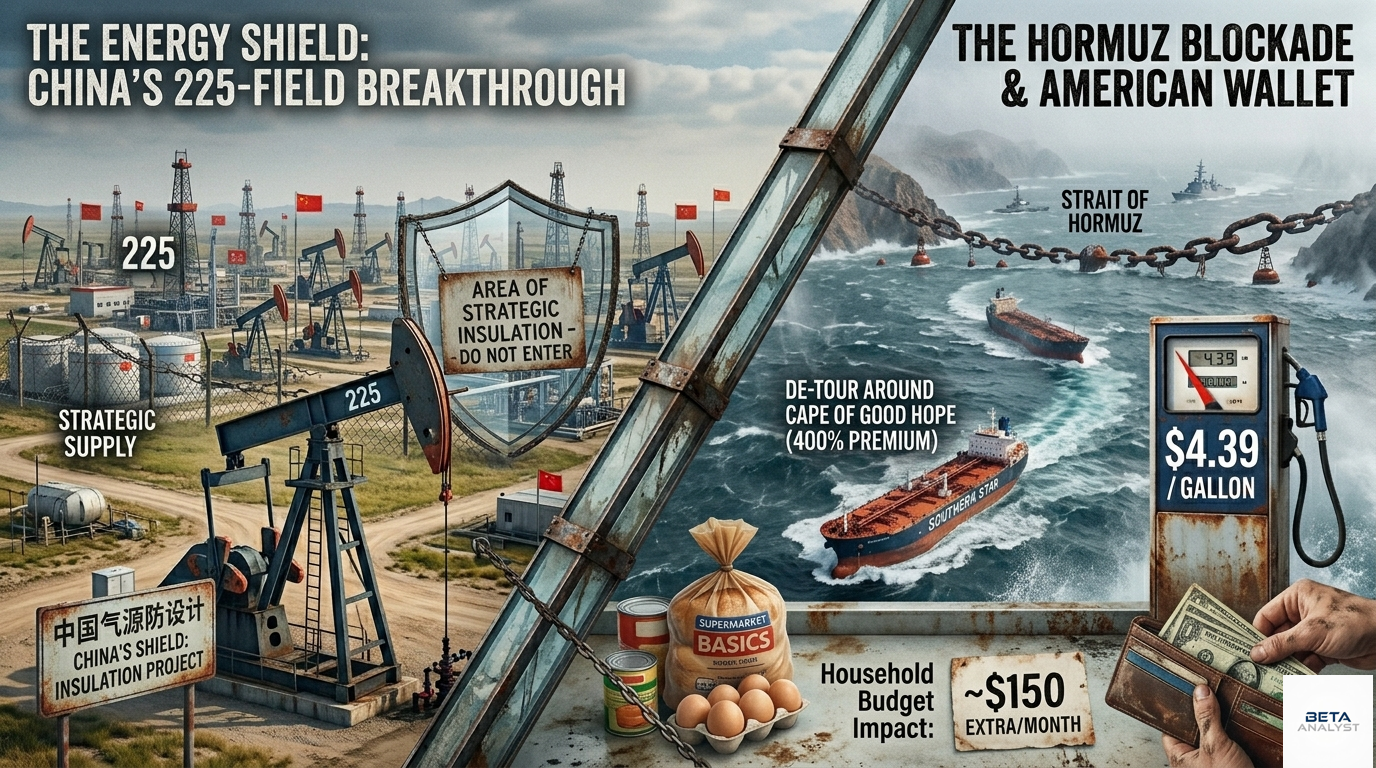
As of today, two massive geopolitical forces are colliding to rewrite the rules of the American household budget. While the headline news focuses on the regional conflict in the Middle East, the structural reality is a "Governance Fracture" in global energy.
With the Strait of Hormuz effectively closed to commercial traffic—reducing tanker flow by over 90%—the U.S. national gas average has surged to $4.39 per gallon, a four-year high. Simultaneously, Beijing has completed a five-year "Energy Shield" project, discovering 225 new oil and gas fields to insulate itself from the very volatility currently crushing the American consumer.
1. China’s "Energy Shield": The Strategic Decoupling
The reports released this week by the Ministry of Natural Resources in Beijing are a landmark in economic forensics. China has invested 450 Billion Yuan ($66 Billion) to increase its proven oil reserves by 51.7%.
The Layman’s Explanation: Imagine your neighbor, who used to buy milk from the same store as you, suddenly builds a private dairy farm. They no longer care if the store raises prices or closes its doors.
The Strategic Result: China is no longer a "Price Taker" in the global oil market; they are becoming a "Sovereign Island."
The American Problem: As China achieves energy self-sufficiency, they lose the incentive to use their diplomatic weight to stabilize Middle Eastern oil routes. This creates a "Bifurcated Market" where the U.S. middle class is left to face global volatility alone.
2. The "Chaos Surcharge": A Structural Tax on Global Trade
When the "Pipes" of global trade are contested, the consumer pays the "Audit Fee." Since the February 28 blockade of the Strait of Hormuz, the "shipping motorway" has been reduced to a trickle of fewer than ten vessels daily.
The Forensic Math: Forced detours around the Cape of Good Hope + a 400% surge in War Risk Insurance Premiums = The Chaos Surcharge.
Household Impact: In May 2026, the average American family is paying an estimated $150 per month extra simply because global trade routes are no longer "Safe." This isn't inflation; it’s a security tax.
3. The "Security Premium": The Real Price of Resilience
There is a bipartisan push to ensure technology and energy are "Homegrown." However, the transition from "Efficiency" to "Reliability" has a high entry price.
The Insurance Policy: View "Made in USA" not as a product, but as a premium. An American-made Electric Vehicle (EV) in 2026 now carries a roughly $3,500 "Security Premium."
The Formula: Price = Manufacturing Cost + (Security * Reliability)
The Verdict: You are paying for the guarantee that a foreign adversary cannot "switch off" your vehicle's supply chain during a conflict.
4. The "Guns vs. Butter" Calculus
The U.S. defense-related budgetary resources for FY 2026 have reached a staggering $2.08 Trillion, with the Department of Defense alone accounting for $1.18 Trillion in committed obligations.
The Opportunity Cost: This is a "Silent Veto" on domestic investment. If the global risk premium were reduced by just 10%, that $118 Billion could eliminate a significant portion of the annual student debt burden or fund a $5,000 childcare credit for every working family.
The Reality: Geopolitical chaos is effectively siphoning wealth directly from American schools and roads into the maintenance of a failing global order.
5. Summary: The Strategist’s Roadmap
We must refuse to be hostages to global "Signature Conflicts." Our roadmap to resilience relies on three pillars:
Energy Sovereignty: Rapidly scaling domestic renewables and next-gen nuclear. No foreign blockade can "switch off" the sun or the wind.
Regional Resilience: Hardening North American supply chains (leveraging Mexico and Canada) to shorten the "Pipes" and reduce insurance exposure.
Stability as Stimulus: In a world of $120/barrel oil, de-escalation is the most efficient economic stimulus package available.
Strategist Q&A
Q: Why are gas prices at $4.39 if China found oil? A: China is hoovering up discoveries into "Strategic Reserves," which reached record highs in late 2025. They are "hoarding" to prepare for conflict, keeping the open market supply tight.
Q: Is "Energy Independence" realistic? A: It is a requirement for survival. China is winning the race to "Energy Powerhouse" status. America must accelerate its domestic "Security Premium" investments or remain a victim of the "Chaos Surcharge."