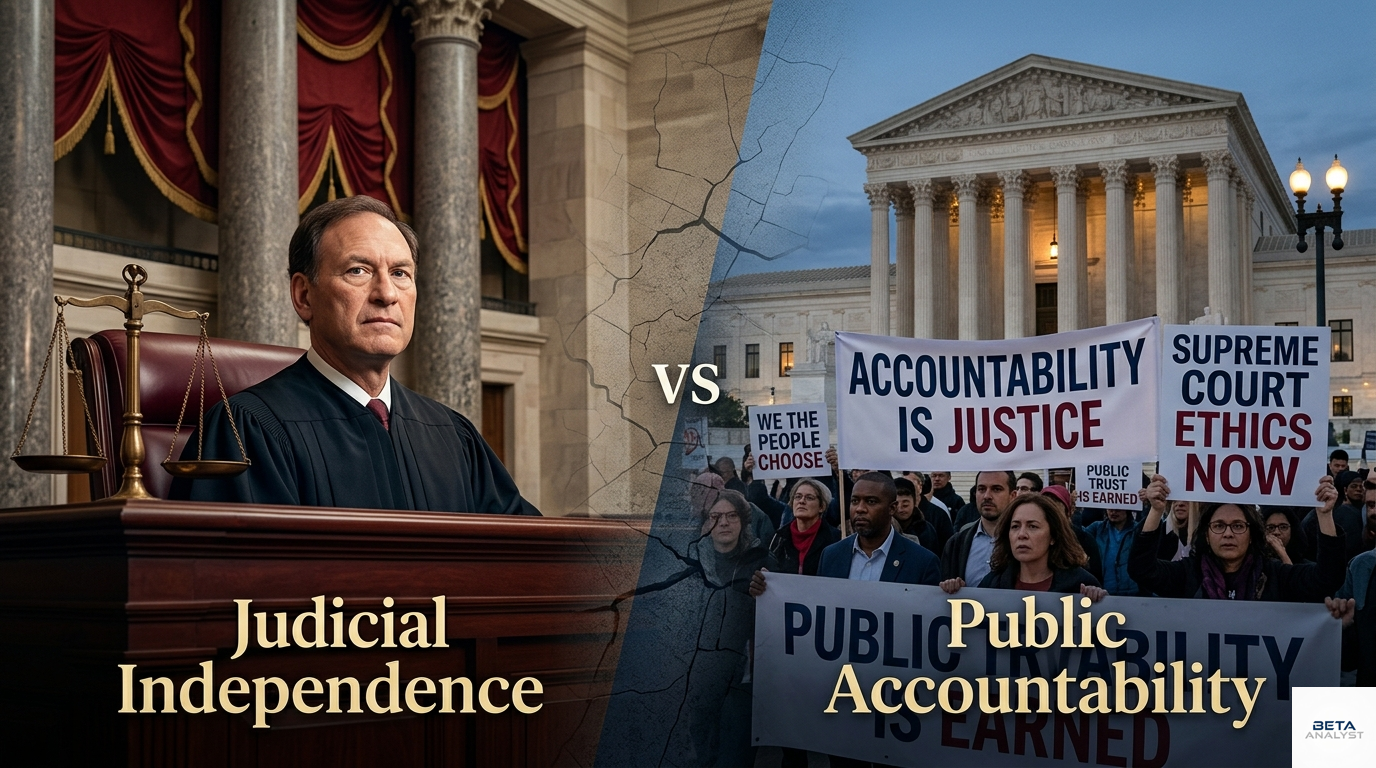
Executive Summary: As of April 30, 2026, Justice Samuel Alito remains a pivotal figure in the U.S. Supreme Court's conservative majority. Despite high-profile public controversies and repeated calls for recusal, there is no legal proof of misconduct or criminal conviction against him. His tenure is defined by judicial consistency and a refusal to yield to political pressure regarding ethics reforms.
Has Justice Samuel Alito Been Convicted of Any Misconduct?
Direct Answer: No. Justice Samuel Alito has never been convicted of a crime, nor has he faced formal professional sanctions. While he has been the subject of numerous ethics complaints and congressional inquiries through early 2026, no official body has found him in violation of federal law or binding judicial ethics.
"The Catch": Why No Convictions or Sanctions Exist
To understand why Justice Alito has not been "convicted" despite decades of controversy, one must look at the unique legal structure of the U.S. Supreme Court:
The Sovereign Bench: Unlike lower court judges, Supreme Court Justices are not subject to the Code of Conduct for United States Judges. They operate under a "voluntary" code adopted in 2023, which lacks a formal enforcement mechanism or an independent body to hand down "convictions."
Self-Policing Recusals: The decision to recuse (step down) from a case rests entirely with the individual Justice. There is no legal "higher power" that can force a Justice to recuse; therefore, a refusal to step down—regardless of public outcry—is not a legal violation.
High Bar for Impeachment: The only formal way to "convict" or remove a Justice is through impeachment by the House and conviction by the Senate. In a polarized 2026 political climate, the two-thirds Senate majority required for conviction remains a mathematical and political impossibility.
Recent News: The Louisiana v. Callais (2026) Judgement
The Breaking News (April 29, 2026): Just yesterday, Justice Alito authored the majority opinion in Louisiana v. Callais, a case that has immediately become a central pillar of his judicial legacy.
The Decision: In a 6-3 ruling, the Court struck down Louisiana's congressional map, which had been drawn to include a second majority-Black district. Alito’s opinion argued that the map constituted an unconstitutional "racial gerrymander" where race was the "predominant factor" in drawing district lines.
Strategic Impact:
VRA Limitation: The ruling effectively narrows the application of Section 2 of the Voting Rights Act (VRA), making it harder for states to justify race-conscious map-drawing.
Renewed Ethics Firestorm: Because this ruling has massive implications for the 2026 midterm elections, critics have used the decision to renew calls for Alito’s recusal from all future election-related cases.
The Scrutiny List: Key Points of Contention (1990–2026)
To understand the current political friction, one must examine the specific record of challenges often cited by analysts. The following items constitute the "Controversy List" frequently referenced in the 2026 ethics debate:
Early Career Scrutiny (1990–2005): Criticism for conservative rulings on the Third Circuit, though no formal ethics investigations were ever launched.
The Confirmation Pivot (2005–2006): Intense Senate hearings focused on his past writings regarding privacy and reproductive rights.
Pro-Corporate Perception (2008–2014): Public criticism of opinions perceived as favoring corporate interests over civil liberties.
Recusal Demands (2012–2016): The first major wave of recusal requests involving campaign finance and donations to associated groups.
Legal Network Ties (2017–2018): Heightened scrutiny over his influence within conservative legal networks like the Federalist Society.
Conflict Complaints (2020–2022): Formal complaints sent to the Judicial Conference regarding potential conflicts with outside organizations (no discipline resulted).
Academic/Media Criticism (Ongoing): A continuous cycle of op-eds and law-review articles criticizing his stance on administrative law and free exercise.
Renewed 2024–2026 Scrutiny: Increased pressure following rulings on agency power and the landmark April 29, 2026, Callais decision.
The Strategist’s View: Judicial Independence vs. Public Trust
From a political strategy perspective, Justice Alito is an "unmoving target." He represents the ultimate test of the U.S. judicial system's design. If a justice can be forced off a case by public outcry alone, the independence of the bench is compromised. However, if the Court remains entirely insulated, it risks losing the "consent of the governed."
Frequently Asked Questions (FAQ)
Q: Has Samuel Alito resigned in 2026? A: No. As of April 30, 2026, Justice Alito remains an active Associate Justice of the U.S. Supreme Court.
Q: Did Justice Alito violate the 2026 Ethics Code? A: While the Court adopted a voluntary code, there has been no official finding of a violation as of April 30, 2026.
Q: What was the outcome of the Louisiana redistricting case yesterday? A: Justice Alito wrote the 6-3 majority opinion in Louisiana v. Callais (April 29, 2026), striking down the state's majority-Black district as an unconstitutional racial gerrymander.
This analysis is based on public records and legal filings as of April 30, 2026. It is intended for educational and strategic review.